For much of the three decades following the Cold War, policymakers often treated international crises as temporary disruptions. A financial shock would eventually stabilize. A regional war would be contained. A diplomatic dispute would be managed before spilling across continents. The assumption was that the international order, despite its imperfections, remained fundamentally stable.
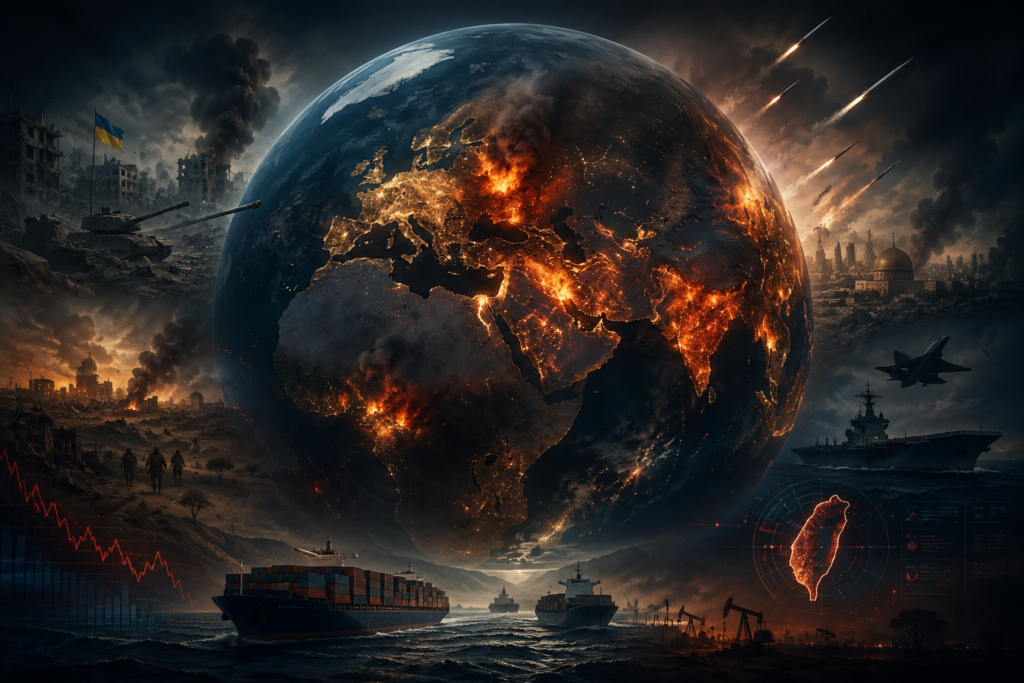
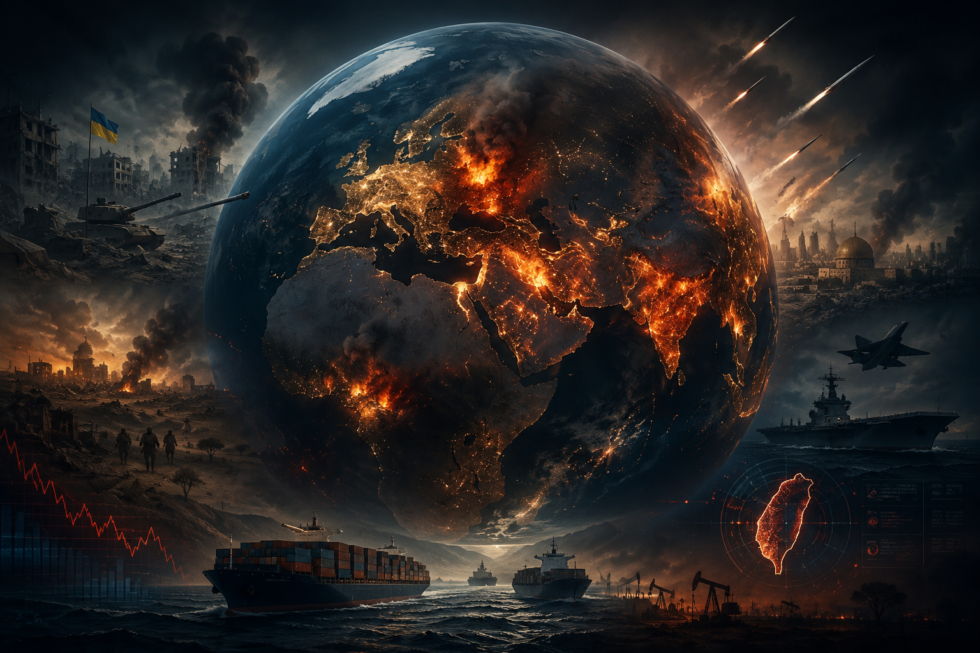
From Ukraine to the Red Sea, from Taiwan to the Sahel, today’s conflicts are no longer isolated emergencies—they are interconnected symptoms of a profound transformation in the international system.
For much of the three decades following the Cold War, policymakers often treated international crises as temporary disruptions. A financial shock would eventually stabilize. A regional war would be contained. A diplomatic dispute would be managed before spilling across continents. The assumption was that the international order, despite its imperfections, remained fundamentally stable.
That assumption is becoming increasingly difficult to defend.
Today’s world no longer appears to move from one crisis to another. Instead, it is experiencing several geopolitical, economic, technological, and security crises simultaneously. Before one conflict cools, another escalates. Before one supply chain recovers, another is disrupted. Governments now confront a strategic landscape in which instability is not an interruption of normal politics—it is becoming the normal condition itself.
This shift reflects something deeper than a series of unfortunate events. It suggests that the international system is undergoing a structural transformation in which competition among major powers, economic fragmentation, technological rivalry, energy security, and regional conflicts increasingly reinforce one another.
The defining characteristic of the current era is not simply that there are more crises. It is that they are becoming interconnected.
The war in Ukraine, tensions between Iran and Israel, instability in the Red Sea, rising military activity around Taiwan, political upheaval across the Sahel, and the intensifying strategic rivalry between China and the United States might appear geographically unrelated. Yet they increasingly influence one another through global markets, diplomatic alignments, military planning, and technological competition.
A conflict in Eastern Europe affects energy prices in Africa. Shipping disruptions in the Red Sea alter inflation across Europe and Asia. Sanctions imposed in one region reshape manufacturing strategies in another. Decisions taken in Beijing influence security calculations in Washington, Tokyo, Brussels, and Canberra simultaneously.
Geography still matters, but geography no longer limits consequences.
This interconnectedness marks a significant departure from the post-Cold War period. During the 1990s and early 2000s, globalization encouraged the belief that growing economic interdependence would reduce geopolitical confrontation. Expanding trade networks, integrated financial systems, and multinational supply chains were expected to make conflict increasingly costly and therefore less likely.
Instead, globalization created new forms of strategic vulnerability.
Countries discovered that dependence on foreign energy supplies, semiconductor production, rare earth minerals, shipping routes, and digital infrastructure could become powerful geopolitical tools. Economic interdependence did not eliminate rivalry; it changed the methods through which rivalry is conducted.
Trade has become an instrument of national security. Technology has become an arena of strategic competition. Supply chains have become geopolitical assets.
As a result, governments increasingly view economic policy through the lens of security rather than efficiency alone.
This explains why the competition between the United States and China extends far beyond tariffs. It encompasses artificial intelligence, advanced semiconductors, quantum computing, telecommunications, critical minerals, maritime influence, and industrial policy. The objective is no longer simply economic growth but strategic resilience.
Once economics becomes part of national security, almost every policy decision acquires geopolitical significance.
The same logic helps explain why regional conflicts no longer remain regional.
The Red Sea illustrates this transformation clearly. Attacks on commercial shipping are not merely local security incidents affecting neighboring states. They influence insurance premiums, shipping costs, global inflation, manufacturing schedules, and energy markets. Companies reroute vessels around southern Africa, extending delivery times by weeks and increasing transportation costs worldwide.
Similarly, developments in the Taiwan Strait concern far more than East Asian security. Taiwan’s central role in advanced semiconductor production means that military instability there could disrupt industries ranging from automobiles and consumer electronics to artificial intelligence and defense manufacturing across the world.
Energy markets demonstrate similar interconnectedness. Tensions involving Iran immediately affect expectations surrounding the Strait of Hormuz, through which a substantial share of global oil exports passes. Even when no major disruption occurs, uncertainty itself influences prices, investment decisions, and government planning.
The result is an international economy increasingly shaped by geopolitical risk rather than commercial predictability.
Meanwhile, instability in the Sahel reflects another dimension of this emerging era.
Political transitions, insurgencies, foreign military withdrawals, expanding external influence from Russia, Türkiye, Gulf states, China, and Western powers, alongside climate pressures and weak governance, have transformed the region into an arena where local conflicts increasingly intersect with global strategic competition.
These developments demonstrate that today’s crises rarely remain confined within national borders. Migration, terrorism, food insecurity, illicit trafficking, and humanitarian emergencies spread across regions, requiring responses that extend far beyond the original conflict zone.
The distinction between domestic security and international security continues to erode.
Another defining feature of this new environment is the disappearance of recovery periods.
Historically, governments often assumed that crises would eventually conclude, allowing political attention and economic resources to return to domestic priorities. Increasingly, however, states must prepare for overlapping emergencies.
Defense budgets continue rising even as governments invest in energy independence, cyber security, industrial resilience, artificial intelligence, food security, and critical infrastructure. Strategic planning now assumes that multiple risks may emerge simultaneously rather than sequentially.
Military establishments speak less about preparing for individual wars and more about sustaining readiness across prolonged periods of strategic competition.
Businesses are making similar adjustments. Efficiency is gradually giving way to resilience. Companies diversify suppliers, relocate manufacturing, increase inventories, and redesign logistics networks—not because these choices maximize short-term profits, but because they reduce exposure to geopolitical shocks.
Resilience has become the defining economic principle of the decade.
For developing countries, especially across Africa and the Horn of Africa, this transformation presents both opportunities and significant challenges.
Competition among major powers can generate investment in ports, infrastructure, energy, telecommunications, and critical mineral development. Countries situated along strategic maritime routes or possessing valuable natural resources may attract increased international attention.
Yet heightened competition also increases the risk that local political disputes become entangled in broader geopolitical rivalries. External partnerships become more complex, diplomatic balancing becomes more delicate, and economic dependence on any single power carries greater strategic consequences.
For the Horn of Africa, located near one of the world’s busiest maritime corridors, global instability is no longer a distant phenomenon. Shipping security, Red Sea competition, Gulf politics, infrastructure investment, energy markets, and great-power rivalry increasingly shape regional opportunities and security calculations alike.
The region is becoming part of the architecture of global competition rather than simply observing it.
Perhaps the most important lesson emerging from today’s international landscape is that crisis itself has become systemic.
The challenge facing governments is no longer preventing every conflict. That goal has become increasingly unrealistic. Instead, states are learning to manage continuous uncertainty while strengthening their capacity to absorb repeated geopolitical shocks.
This represents a profound change in strategic thinking.
For decades, policymakers assumed that periods of instability would eventually give way to renewed stability. Increasingly, the opposite assumption is guiding national planning: stability may become temporary, while competition remains permanent.
That does not necessarily mean the world is destined for endless war. Cooperation will continue in many areas, diplomacy will still matter, and individual conflicts will eventually end.
But the broader environment appears fundamentally different.
The emerging international order is characterized not by isolated crises but by overlapping competitions involving military power, economics, technology, energy, information, and geography—all interacting simultaneously.
The question, therefore, is no longer whether the next crisis is approaching.
It is whether the world has entered an era in which crisis itself has become the defining feature of international politics.
The evidence increasingly suggests that we are witnessing more than a turbulent moment. We are living through a historic transition from an international system built on expectations of stability to one organized around the management of permanent uncertainty. In that world, governments, businesses, and societies will not measure success by avoiding crises altogether, but by developing the resilience to endure and adapt to them. Permanent crisis may not mean permanent conflict—but it is rapidly becoming the new normal of global politics.